
TOP > コンピュータ > machii-little道場 > ネタ
道場TOP ネタ一覧 machii-little道場
Let's talk about the Parrot Bebop 2 drone—and the "Power" edition
- ◇評価 0ポイント
- ◇閲覧回数 10回
- ◇登録日
- 2026年9月17日
-
- machii-little
- 道場主
Lv.31
For a while, I was really into drones and wanted to get one that was fun to fly without breaking the bank. I looked at DJI, but even their cheapest model at the time, the Spark, cost over 3,000 yuan—more than I was willing to spend. Later, while browsing the second-hand market, I came across the Parrot Bebop 2. It was a French brand, significantly cheaper, weighed 500 grams, and looked decent, so I picked one up. I also experimented with the batteries for the "Bebop 2 Power" version later on, so I’ve pretty much got the hang of this series.
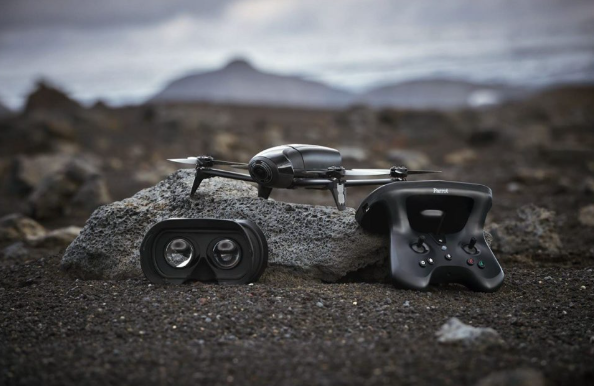
First, let's look at the drone itself.
The Bebop 2 was released in late 2015 by the French company Parrot. It was positioned as a recreational drone—basically, something for entry-level hobbyists. The whole unit weighs 500 grams and is compact, measuring 382 x 328 x 89 mm; it feels lighter in the hand than you’d expect. The frame is made of fiberglass-reinforced PA12 material; it feels a bit like hard plastic to the touch but is actually quite sturdy. It doesn't have a mechanical gimbal; instead, it uses a fixed 14-megapixel fisheye lens. It shoots 1080p video at 30 fps and supports RAW format for photos. The lens is located at the nose of the drone and comes with a protective cover.
Its rated horizontal flight speed is 60 km/h, with a vertical climb rate of 21 km/h; it takes 14 seconds to reach top speed and 4.5 seconds to come to a full stop. It’s rated to withstand winds of up to 63 km/h (Force 8 on the Beaufort scale)—a figure I find a bit exaggerated—though it does hover quite stably in Force 3 or 4 winds.
One detail worth mentioning is that the drone is controlled via Wi-Fi using a smartphone or tablet, though you can also use the "Skycontroller" remote. When using a phone, the video feed clarity is decent, but the connection isn't always stable. I tried flying it in an open park; I still had two bars of signal at around 100 meters, but whenever I got near buildings, I’d often get "connection lost" warnings—though switching to the 5GHz frequency band improved things significantly. If the connection drops, it hovers in place and automatically returns to the launch point after a minute; this logic is reliable enough to prevent it from simply drifting away. What exactly does the "Power" version offer?
The Bebop 2 Power was released in 2017; visually, it is almost identical to the standard version, save for slight color differences and variations in the power button and indicator lights. The biggest change is the battery: it was upgraded from 2700mAh to 3350mAh, boosting the rated flight time from 25 minutes to 30 minutes. Additionally, the Power version comes with two batteries in the box, providing a combined flight time of nearly an hour. Software-wise, it adds modes like "Hand Launch" and "Orbit" (spiraling around a subject), though—to be honest—the novelty wears off quickly, and I rarely use them.
With the increased battery capacity came a change in chargers. The Power version ships with an "HD charger"; the standard version's charger cannot fully charge the Power battery, topping out at around 90%. Conversely, using the Power version's HD charger on a standard battery can lead to overcharging and voltage issues. The connectors on the two chargers differ in size—a physical safeguard against mistakes—but if you own both types of batteries, it is easy to mix them up. I nearly grabbed the wrong one at first and only felt at ease after marking the chargers with a permanent marker.
The good news is that the batteries themselves are interchangeable; a Power battery works on the standard Bebop 2, extending flight time to nearly 29 minutes. However, you must use the correct charger for the specific battery—that is a crucial detail to remember.
How is the image quality?
The Bebop 2 lacks a mechanical gimbal, relying instead on software-based image stabilization and the ultra-wide field of view of its fisheye lens. Still photography is decent; the 14-megapixel sensor captures sufficient detail in good daylight, and it supports RAW format. Video quality, however, is mediocre. At 1080p/30fps, the footage feels somewhat "smoothed over," with details in dark areas tending to blur together. Some reviews suggest a noise-reduction filter was added; while this improves low-light performance, it makes the image look "soft" or lacking in crispness under normal lighting. Compared to contemporaries like the DJI Phantom 3 or Spark, the image quality is a tier below; those models offer 4K resolution and mechanical gimbals, whereas the Bebop 2's 1080p footage looks a bit soft and lacking in definition.
Then again, looking at it from another perspective, it is positioned as a fun toy rather than a tool for serious aerial photography. If you just want to share clips on social media or document your outings, the image quality is perfectly adequate. If you really want to get good footage, DJI is still the way to go.
The motor issue deserves a mention of its own.
I’ve seen quite a few reports on forums and Amazon about motor failures—it’s not an isolated incident. One user was flying normally at an altitude of 40 meters in clear weather when a motor suddenly stopped spinning completely; the drone slid sideways, plummeted, and crashed into a tree. When he contacted Parrot support, their initial reaction was to claim he "must have hit something," refusing to take responsibility. It wasn't until he sent them his app's flight data and video footage—proving there had been no collision—that they reluctantly agreed to a replacement. The process dragged on for weeks; they even took away his charger, and the replacement they sent had a port that didn't match the original cable, making it impossible to charge the Skycontroller. He tried contacting them again for the correct charger, but his messages went unanswered.
Others on the forums reported opening up their units to find the front-left motor dangling, having detached from its wiring. In another case, a loose motor screw—loosened by vibration during flight—caused the propeller to strike the drone arm; the prop snapped, resulting in a crash. Many others chimed in on these threads, reporting similar issues. Of course, it’s possible the motor came loose *after* the crash—the cause-and-effect is hard to pin down—but the assembly quality of the motor screws and connectors is certainly concerning.
My own unit hasn't had this problem so far, but before every takeoff, I manually spin all four propellers to listen for odd noises and check for loose motors. I also don't dare fly too far away; I generally keep it within a 100-meter radius.
How does it compare to DJI?
When compared to DJI models from the same era, the gap is obvious. The video transmission stability falls short of DJI’s Lightbridge system; the Wi-Fi transmission suffers from noticeable latency and compression artifacts, and the image exhibits a "jello effect" during fast flight. The image quality is a tier lower, and the lack of a mechanical gimbal places a hard limit on video quality. There is absolutely no obstacle avoidance, so you have to rely on your own eyes while flying. The Skycontroller 2 feels decent in the hand, but if you buy just the drone and control it via smartphone, precision depends entirely on your fingers; the virtual on-screen joysticks lack haptic feedback, making fine control difficult.
But then again, the price reflects that. Back in the day, the Bebop 2 (drone only) cost 3,998 RMB, while the bundle with the Skycontroller was around 5,000 RMB—roughly the same price as the Spark bundle. However, the Spark offered a superior video transmission and flight control experience. If you’re on a tight budget and just want to see if you enjoy flying, a used Bebop 2 is very cheap now and works fine as an entry-level toy. But if you care about image quality and flight stability, it’s better not to skimp here.
Let’s get real.
By today’s standards, this drone is definitely outdated; it wasn't until Parrot released the Anafi that they had a product capable of truly competing with DJI. The Bebop 2 was a budget-friendly option for its time—decent battery life and beginner-friendly controls—but it suffered from mediocre image quality, unstable video transmission, and potential issues with motors and customer support.
Who is it for? If you want to experience flying a drone for very little money, don't mind average image quality, and are careful not to fly too far away, picking up a used one to play around with is a fine idea. Who is it *not* for? If you want to shoot high-quality footage, need long-range and stable flight, or want to avoid the hassle of dealing with after-sales support, you should look elsewhere. Personally, I only take mine out occasionally to fly a few laps in an open area within my residential complex, snap a few photos, and pack it up; I don't expect it to do any heavy lifting.
Drone Battery BEBOP-2 For PARROT Bebop 2, Bebop power drone
|
|
【キーワード】
登録されていません
|

|
  |
ブログ? そんなの必要ありません! 今日から、いきなりアフィリエイトスタート!
【まにあ道アフィリエイト】まにあ道ならAmazonアソシエイトIDを利用してネタを書くだけで、お気軽に始めていただけます。


 Let's talk about the Parrot Bebop 2 drone—and the "Power" edition(0)





 シュリのおすすめネタ
 この道場の人気ネタ
-

Replacement battery Bluetooth speaker ... -
Replacement battery Bluetooth speaker ... -
Precision 7540: A "Piece of Gym Equipm... -
Cell phone battery BLPB21 OPPO OPPO Re... -
Universal battery Hikvision 553640PL-1...
このネタをソーシャルブックマークに登録する
 まにあ道の人気ネタ
-
有名人の素顔公開 【デーモン小暮閣下 樽美酒研二 マツコデラックス など】 -
【全国送料無料】OPPO K12 交換用バッテリー BLPB45 -
Venta al por mayor y al por menor de l... -
TECNO BL-50FT 5060mAh/19.84Wh 3.92V Li... -
Batterie de tablette Li-ion LENOVO 704...
コメントはまだありません。